Blog
Chicken House Construction and Agrotop’s Role
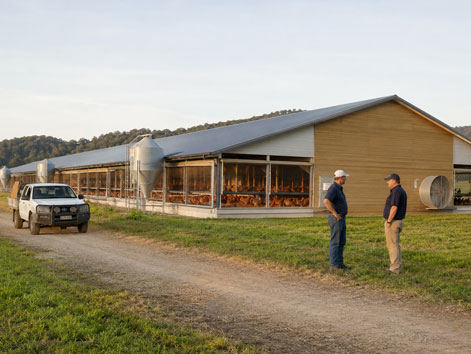
Chicken house construction has become a central part of modern Poultry Farming. A chicken house is no longer a simple shed with birds inside. It is a controlled production environment where structure, ventilation, insulation, equipment, bird welfare, labour efficiency and biosecurity all affect the final commercial result.
The first stage in chicken house construction is understanding the production objective. A Broiler House for Poultry meat production is different from a breeder house, a layer house or a rearing house. Stocking density, bird age, ventilation rate, feeding system, lighting programme, manure handling and cleaning method all influence the design. A good poultry building starts with the production system and then turns that system into a practical structure.
Site selection is one of the most important decisions. The land must allow good access, drainage, water supply, electricity, feed delivery, bird transport and manure removal. The site should also support biosecurity, with proper distance from other farms, controlled vehicle movement and clear separation between clean and dirty areas. Poor site planning can create permanent operational problems that are difficult to correct later.
Chicken House Construction – The Structure
The structure of the house must be strong, durable and suitable for the local climate. In hot regions, insulation, air speed and cooling capacity are critical. In colder regions, insulation, heating efficiency and air tightness become more important. In humid areas, the house must be designed to manage moisture and litter condition. A poultry house should be built for the climate it will actually face, not copied from a standard design without adjustment.
Ventilation is one of the most important systems in chicken house construction. Birds need fresh air, oxygen, temperature control, humidity control and removal of ammonia, carbon dioxide and dust. Modern houses usually use controlled ventilation with fans, inlets, sensors and a controller. Minimum ventilation, transitional ventilation and tunnel ventilation must work together through the production cycle. If the house is not tight, or if the air inlets and fans are not matched correctly, bird performance will suffer.
Insulation & Air Tightness in Chicken House Constructions
Insulation and air tightness are also commercial issues. A well-insulated house saves energy, improves temperature control and helps maintain stable growing conditions. Air leaks reduce control and create uneven bird distribution, wet litter and heating or cooling losses. Good construction quality directly affects daily production costs.
Floor design and litter management are important in Broiler House construction. The floor must be level, strong, easy to clean and suitable for dry litter. Dry litter supports bird health, footpad quality, ammonia control and general welfare. The house should be designed so that litter can be managed, removed and replaced efficiently between flocks.
Equipment layout must support both bird performance and daily work. Feed lines, drinker lines, brooders or heaters, lights, sensors, fans, cooling pads and control panels should be positioned for easy operation and maintenance. A technically advanced house can still perform badly if workers cannot manage it simply and consistently.
Biosecurity should be included in the construction plan from the beginning. This includes controlled entry, changing areas, vehicle routes, feed delivery points, dead bird handling, water treatment, drainage and cleaning access. Biosecurity is easier and cheaper to build correctly at the start than to add later.
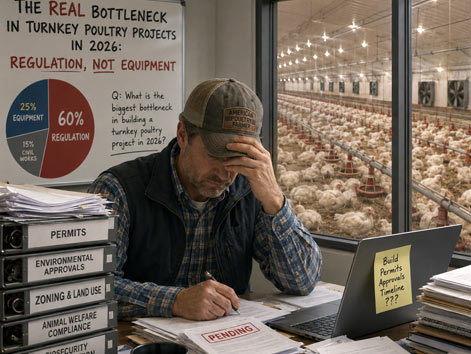
Environmental management is becoming more important in Poultry Projects. Manure, litter, odour, dust, flies, wastewater and nutrient use all need to be considered. A modern project should include a clear plan for litter removal, composting, storage or field application. Environmental planning protects the farm, supports permits and improves acceptance by surrounding communities.
What to Consider
Chicken house construction also needs to consider future expansion. Roads, utilities, feed bins, water tanks, electrical systems and manure handling should be planned so that additional houses can be added without disrupting the first phase. Many successful Turnkey broilers projects begin with a first group of houses and expand after performance is proven.
Agrotop brings value by connecting poultry engineering with practical farm operation. The company designs and builds poultry houses as part of complete Poultry Projects, including Broiler House construction, layer houses, breeder farms, Hatchery projects, Feed Mill integration and complete Broiler integration. This wider view helps ensure that each house fits the production plan, the customer’s market and the long-term operation of the farm.
Agrotop’s role includes site planning, structural design, equipment selection, ventilation planning, climate control, automation, biosecurity layout and project execution. For investors and growers, this reduces risk because the building, equipment and production objective are planned together.
Good chicken house construction creates a stable environment for birds and a practical working system for people. It improves growth, feed conversion, mortality, welfare, labour efficiency and energy use. The strongest poultry projects are built around this principle: the house is not only a structure, but the production platform for the whole business.
By Stanley Kaye M.B.A Business Development