Blog
Integrating Solar Power in Poultry Farms: 8 Key Insights from a Hybrid Energy Case Study
Article by Stanley Kaye, MBA
Stanley Kaye, MBA, has worked hands-on in the poultry industry for over 35 years, combining his practical experience with a degree in economics and an MBA.
Modern Broiler House Design – Integrating Solar Power in Poultry Farms: 8 Key Insights from a Hybrid Energy Case Study.
Agrotop has long been committed to integrating renewable energy into poultry operations to improve sustainability and profitability. A recent open-access study by Simonson (2023) on a North Carolina poultry farm underscores how solar photovoltaic (PV) panels, battery storage, and diesel generators can work together to cut energy costs. Below, we present eight clear takeaways from this case study—lessons that apply to poultry farms worldwide—in accessible terms.
Key Takeaways from the PV–Diesel–Battery Study
1. Energy Costs In a Modern Broiler House Design Are a Big Deal.
Energy bills are often the second-highest expense for poultry growers (just behind housing costs). Generating renewable energy on-site can therefore have a significant impact on the bottom line (Simonson, 2023).
2. Batteries Aren’t Always Worth It (On-Grid).
For farms connected to the grid, the study found that high battery prices made standalone storage uneconomical. Instead, pairing solar panels with the grid for evening and emergency power proved most cost-effective (Simonson, 2023).
3. Cheap Electricity Can Limit Solar’s Benefits.
When utility rates are very low (around $0.05 per kWh), even with net-metering credits, large solar investments struggle to pay back. In the North Carolina example, low local rates meant only a small PV array was justified (Simonson, 2023).
4. Higher Power Rates In A Modern Broiler House Design Make Solar Attractive.
Conversely, in areas paying $0.08 per kWh or more, solar-plus-net-metering becomes compelling. Under these conditions, a full-size PV system delivered clear savings, showing that farms with higher tariffs or strong incentives gain the most (Simonson, 2023).
5. Off-Grid Comes with an Emergency Backup Cost.
Running totally off-grid requires a substantial PV array (≈250 kW) plus nearly 400 kWh of batteries—and crucially, a diesel generator that’s always on standby. This permanent backup need drives the lifetime cost roughly 40–50 % above grid-tied setups. However, as battery prices continue to fall rapidly, these economics may swing in favor of off-grid systems sooner than expected (Simonson, 2023).
6. Diesel Generators Still Play a Role.
Even with large solar and storage, a generator remains vital for reliability—especially on completely off-grid farms or during multi-day overcast periods. Solar simply reduces generator run-time, cutting fuel deliveries, downtime, and emissions (Simonson, 2023).
7. Fuel Prices Greatly Affect Savings.
Diesel cost proved the single biggest driver of off-grid system economics. When fuel prices rise, solar PV and batteries deliver ever-greater savings. Farms dependent on generators should monitor fuel markets closely when sizing renewables (Simonson, 2023).
8. A Modern Broiler House Design With Future Trends Favor Solar Solutions.
With solar module costs already declining and battery technologies advancing, the study notes that a further 20–30 % drop in equipment prices would make PV—and even battery storage on-grid—attractive in most regions. Early adopters thus position themselves for rapidly improving returns (Simonson, 2023).
Conclusion: Planning Your Farm’s Energy Future
There’s no one-size-fits-all answer. The right hybrid mix depends on local power prices, sunlight availability, and your farm’s energy profile. Beyond the direct economic benefits, a reduced carbon footprint is increasingly valued by retailers, integrators and end-consumers. Another area where renewables pay dividends. At Agrotop, we guide poultry growers through detailed techno-economic studies (using tools like HOMER®) for a modern broiler house design to get the optimal PV, battery and backup systems for each farm. By balancing cost savings, reliability and sustainability, we help clients worldwide with planning a modern broiler house design to build energy-resilient operations ready for the future.
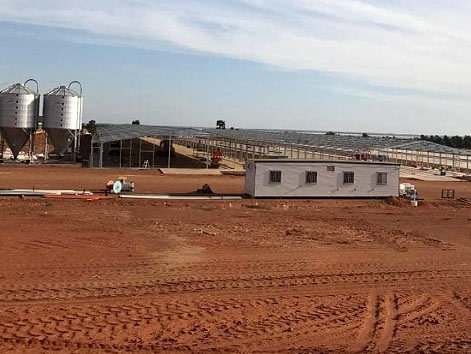
In the picture, there is an Agrotop farm with a large solar power system generating power for the farm and also selling excess to the grid.
Reference
Simonson, D. (2023). Techno-Economic Assessment of PV–Diesel–Battery Hybrid Systems for Poultry Farms via HOMER®. Resources, 12(1), Article 130. https://doi.org/10.1016/j.egyr.2025.01.0130
Available at: https://www.sciencedirect.com/science/article/pii/S2772427125000130