Blog
Designing and Building a Modern Feed Mill: From Grain Silo to Finished Feed
Feed Mill Project
A modern Feed Mill is more than a collection of machines. It is a continuous process that starts with grain arriving at the gate and ends with safe, consistent feed that drives Poultry Farming performance. Whether for Broiler House complexes, Egg Production units, or other livestock. When Agrotop designs and builds a feed mill as a turnkey project, the goal is simple: stable quality at the lowest sustainable cost per ton, matched to the realities of the local market and farm system.
Start at the Beginning: Grain Source and Silo Strategy.
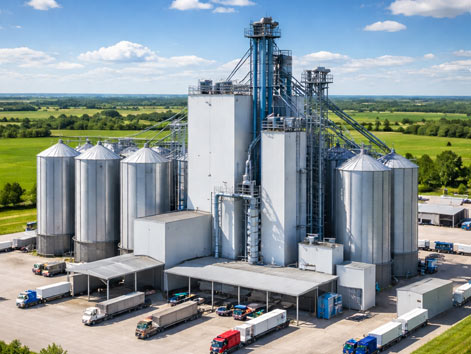
Good feed starts with good grain. That means the engineering of the feed mill must be tied to where grain will come from, how often it will arrive, and in what form. In many Poultry Projects, it is worth investing not only in the mill itself but also in a dedicated grain silo complex.
A silo system like the one built in the Chirina project in Georgia allows the owner to buy grain at harvest time when prices are lowest, then store it in controlled conditions to preserve quality. Proper aeration, temperature control, and fumigation systems keep grain dry, cool, and free from pests. This is not an “extra”; it is a financial tool and a quality tool at the same time, stabilizing feed cost throughout the year and securing the most critical raw material for Poultry meat production and Egg Production.
Feed mill project – Key design questions at this stage:
- What is the typical harvest pattern (one harvest per year or multiple)?
- How much storage is needed to cover the mill between deliveries?
- What reception and pre-cleaning capacity is required at peak intake?
One Mill or Many Feeds? Species and Product Mix
The next strategic choice in a feed mill project is: what species and what products will the mill serve?
- An all-purpose feed mill project supplying different types of poultry (broilers, breeders, layers, turkeys) and possibly ruminant or pig feed needs a larger variety of raw materials and additives. That means more ingredient silos, more micro-dosing stations, and more complex formulation management. The layout must allow parallel lines, flexible routing, and easy cleaning when switching products.
- A single-species mill, for example dedicated only to layers, can be simpler. Fewer raw materials, fewer formulations, and shorter product lines can reduce both CAPEX and OPEX.
Agrotop’s design work starts with a clear product map: which feeds, for which ages, in which physical form (mash, pellets, crumbles), and in what daily tonnage. Only then is it possible to size grinding, mixing, and dosing systems correctly and to decide how many bins and silos are truly needed.
Do You Really Need Pellets?
Pelletising is a major cost driver in a feed mill project design. It adds equipment (conditioners, pellet mills, coolers, crumblers), increases power consumption, and raises maintenance requirements. For broilers and many other species, pellets or crumbles are usually justified by better feed intake, lower wastage, and faster growth.
Layers are different. In many markets, commercial layer feed is supplied as mash. Birds eat well on mash, and egg output is not significantly improved by pelleting. For a layer-focused mill, it is often more economical to stay with mash and design for excellent grinding and mixing instead of investing in full pelleting capacity.
In practice, Agrotop will ask:
- Which feeds absolutely require pellets or crumbles?
- Are there regulatory or customer expectations about physical form?
- Is it better to design for mash now but allow structural space to add pelleting later if the market changes?
This decision can shave a significant amount off the initial CAPEX and simplify operation, especially in smaller Turnkey broilers or Egg Production projects.
Location and Biosecurity: On-Farm vs. Independent Site
Where the feed mill is built is not just a logistical question; it is a biosecurity question.
- If the mill is producing only for one farm or one production campus. Locating it on or next to the farm can be efficient. Transport distances are short, coordination is simple, and there is tight control over who and what enters the site.
- If the feed mill project is also selling feed to other farms, it is usually better practice to place it on a separate site. Trucks will arrive from many different farms with different health statuses. Keeping that traffic away from breeder houses, layers, and broiler farms reduces the risk of bringing disease directly into the heart of the production system.
In both cases, Agrotop’s design will plan clear truck routes. Defined clean/dirty zones, washing and disinfection facilities where appropriate, and controlled access to raw material reception and finished feed loading. For a commercial feed mill project serving external clients, biosecurity is not a “nice to have”. It is central to the business model and to the brand.
Feed mill project core Engineering: Capacity, Flow, and Automation
Around these strategic choices sit the classic engineering questions:
- Capacity and modularity – The mill must be sized for realistic current throughput but designed so that extra bins. Additional pelleting lines, or more packing stations can be added later with minimal disruption.
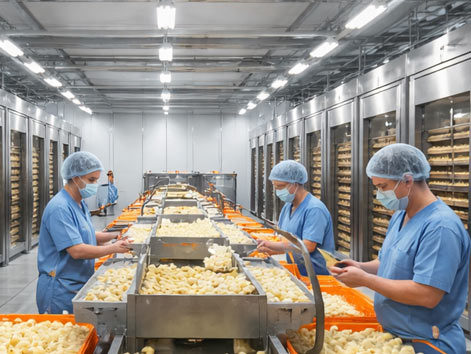
- Process flow – From intake, pre-cleaning, drying (if needed). Grinding, mixing, pelleting/crumbing (if used), cooling, sieving, to bulk loading or bagging. The flow should be simple, gravity-assisted where possible, and easy to clean.
- Automation level – High automation can cut labor and improve accuracy, but it costs money. In high-wage countries, it often pays back quickly. In lower-wage environments it may be better to invest in robust, semi-automatic solutions and more human oversight.
- Quality Control – Space, access, and equipment for QC must be part of the design from day one: sampling points, a lab or at least a test room, and integration into production data systems.
Agrotop’s Role: Turning Concept into Reliable Capacity
For Agrotop, a feed mill project is a strategic piece of infrastructure that underpins the performance of every Poultry Project we deliver. Whether the mill is serving one site or a whole region. Whether it is multi-species or dedicated to layers, the design and construction process is anchored in these principles: secure grain sourcing, clear product definition, smart decisions on pelleting, biosecure siting, and robust, modular engineering.
Done well, the Feed Mill Project stops being a “black box cost” and becomes a controlled, predictable engine for performance in Poultry Farming, from Broiler House to layer farm and beyond.